

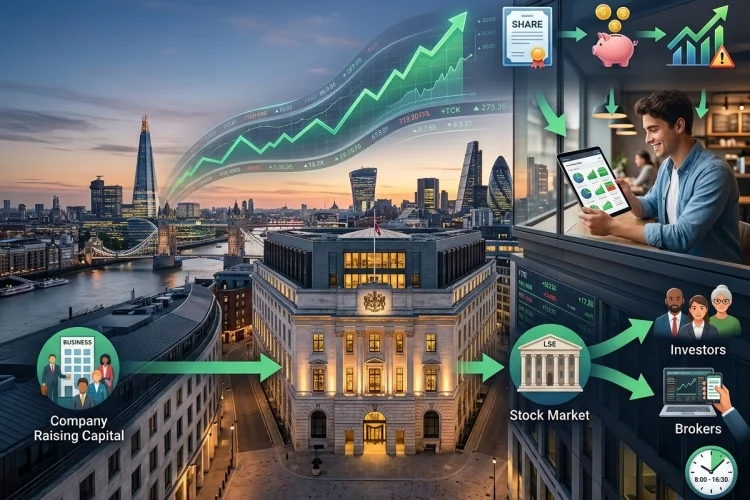
The UK stock market can look like a confusing collection of flashing prices, unfamiliar company codes, and financial headlines about the FTSE 100.
Behind all that activity, however, the basic idea is fairly simple: companies use the market to raise money, while investors use it to buy and sell ownership stakes in those businesses.
When you purchase a share, you become a small part-owner of the company. If the business grows and attracts more investor demand, its share price may rise. Some companies also distribute part of their profits to shareholders through dividends.
Understanding how the UK stock market works does not require advanced mathematics or professional trading experience. You mainly need to know where companies are listed, how orders are processed, what moves share prices, and how investors may earn – or lose – money.
This beginner-friendly guide explains the system in plain English, from the London Stock Exchange and FTSE indices to brokers, market hours, settlement, and investment risk.
What Is the UK Stock Market?
The UK stock market is a network where shares and other financial securities are issued and traded. Its best-known exchange is the London Stock Exchange, commonly shortened to the LSE.
The market performs two important jobs. First, it allows companies to raise capital from investors. A business might use that money to open new locations, develop products, acquire another company, reduce debt, or expand internationally.
Second, it creates a secondary market where investors can trade shares that have already been issued. When you buy shares through an investment platform, you are usually purchasing them from another market participant rather than directly from the company.
This secondary market creates liquidity. In simple terms, it gives investors an opportunity to turn their shares back into cash, although finding a buyer at an attractive price is never guaranteed.
The Main Market and AIM
Not every company on the London Stock Exchange belongs to the same market. Two of its most recognised areas are the Main Market and AIM.
The Main Market includes businesses from a wide range of industries and countries. Companies whose securities are admitted to the FCA’s Official List must follow applicable listing, disclosure, transparency, and governance requirements.
The LSE describes the Main Market as an international capital market with disclosure-based regulation overseen by the Financial Conduct Authority.
AIM was created for growing businesses at different stages of development. It can give smaller or earlier-stage companies access to public capital, but these businesses may have shorter operating histories and greater uncertainty than established corporations.
Being traded on AIM does not automatically make a company a poor investment. It simply means investors should pay close attention to issues such as liquidity, financial resilience, management experience, and business risk.
How Companies Enter the Market
A private company can become publicly traded through an initial public offering, better known as an IPO. During this process, shares are offered to investors and admitted to trading on a public market.
The company normally prepares detailed documents explaining its business model, finances, leadership, risks, and intended use of the money raised. Advisers, accountants, lawyers, investment banks, regulators, and the exchange may all have roles in the process.
After admission, investors can trade the shares on the secondary market. The company does not receive money whenever two investors trade with each other, although it may raise additional capital later by issuing more shares.
Public companies must also communicate important information to the market. Announcements may cover financial results, management changes, acquisitions, dividend decisions, and other developments that investors could consider material.
How Investors Buy and Sell UK Shares
Individual investors do not normally send orders directly to the London Stock Exchange. Instead, they open an account with a stockbroker or online investment platform.
When you decide to buy, you enter the company name or ticker symbol, choose the number or value of shares, and submit an order. The broker then routes that instruction to an appropriate trading venue.
The LSE’s flagship electronic order book is called SETS. It is used for securities including FTSE 100 and FTSE 250 shares, exchange-traded funds, and various other liquid instruments. The system brings together purchase and sale orders electronically.
A market order generally prioritises completing the trade at the best available price. A limit order allows you to set the highest price you will pay or the lowest price you will accept, although the order may not be completed.
Understanding the Bid-Ask Spread
The bid is the highest price a buyer is currently offering. The ask, or offer, is the lowest price at which a seller is prepared to sell.
The difference between them is known as the spread. Frequently traded large-company shares usually have narrower spreads than smaller or less liquid securities.
Wide spreads can increase trading costs. A share may need to rise simply for an investor to recover the difference between the buying and selling prices.
UK Stock Market Trading Hours
The London Stock Exchange’s regular trading day generally runs from 8:00 a.m. until 4:30 p.m. London time on eligible business days. The day includes opening and closing processes that help establish market prices.
Orders can sometimes be submitted outside these hours through an investment platform, but they may remain pending until the market opens. Prices can change before an order is executed, especially when major news appears overnight.
The market is normally closed on weekends and selected public holidays. It may also operate shorter sessions around certain holidays.
Trading hours should not be confused with investing hours. Long-term investors do not need to watch prices throughout every market session. Constant monitoring can encourage emotional decisions based on temporary movements rather than business performance.
What Are the FTSE 100, FTSE 250, and FTSE All-Share?
A stock market index tracks the performance of a selected group of securities. It provides a quick way to understand how a particular section of the market is behaving.
The FTSE 100 contains the 100 most highly capitalised blue-chip companies listed on the London Stock Exchange. Because it includes many large international businesses, its performance can be affected by global demand, commodity prices, currencies, and overseas economic conditions.
The FTSE 250 covers medium-sized companies outside the FTSE 100. These businesses are often considered more closely connected to the domestic UK economy, although many also operate internationally.
The FTSE All-Share combines the FTSE 100, FTSE 250, and FTSE Small Cap indices. FTSE Russell states that it represents approximately 98–99% of UK market capitalisation, making it a broader measure of the London equity market.
You cannot purchase an index directly. However, index funds and exchange-traded funds can aim to track its performance.
Why UK Share Prices Move
A share price changes as buyers and sellers respond to new information. When demand is stronger than the available supply at the current price, the price tends to rise. When more investors want to sell, it may fall.
Company-specific developments are a major influence. Revenue growth, profit margins, debt levels, leadership changes, new contracts, disappointing forecasts, and dividend announcements can all affect investor expectations.
Broader conditions matter too. Interest rates influence borrowing costs and the attractiveness of other investments. Inflation can increase company expenses, while exchange-rate movements may affect businesses earning money overseas.
Market sentiment also plays a role. Prices sometimes move beyond what a company’s immediate financial results appear to justify because investors become unusually optimistic or fearful.
This is why a rising share price does not always prove that a business is strong, and a falling price does not automatically mean it is worthless. Investors still need to examine the underlying company.
How Investors Make Money
Investors can potentially earn money in two main ways: capital growth and dividends.
Capital growth occurs when shares are sold for more than their purchase price. If you buy shares for £500 and later sell them for £650, the gain is £150 before fees and any applicable tax.
Dividends are payments that some companies make from their available profits or reserves. A business may pay dividends once, twice, or several times a year, but there is no guarantee. The board can reduce, cancel, or postpone them when conditions change.
Total return combines share-price performance with income received. Focusing only on the price chart may therefore provide an incomplete view of an investment’s results.
UK investors may hold eligible shares and funds inside a Stocks and Shares ISA. For the 2026/27 tax year, the overall ISA subscription limit is £20,000, and investment returns within the wrapper can receive favourable UK tax treatment under the applicable rules.
What Happens After a Trade?
Seeing a completed trade in an investment app does not mean every behind-the-scenes step happens instantly. The transaction must go through clearing and settlement.
Settlement is the process through which ownership of the securities and payment are formally exchanged. Most UK cash-security trades currently use a two-business-day standard, commonly called T+2.
The UK government has committed to making T+1 the standard from October 11, 2027. Under that system, a typical transaction would settle one business day after the trade is agreed.
For many retail investors, the broker handles these processes automatically. However, settlement timing can affect when sale proceeds become fully available for withdrawal or reuse.
The Risks of Investing in UK Shares
Shares can create long-term growth, but their values are not guaranteed. A company can lose customers, take on too much debt, face regulation, suffer poor management, or fail completely.
Investors also face market risk. Even financially healthy companies can fall during recessions, financial crises, political uncertainty, or periods of widespread selling.
Smaller shares may have additional liquidity risk. A limited number of buyers can make it harder to sell quickly without accepting a lower price.
Diversification can reduce dependence on one business or industry, but it cannot remove every loss.
The FCA recommends understanding the investment, checking fees, using authorised providers, spreading risk, and taking a long-term view. It also warns that higher potential returns normally involve greater risk.
The UK stock market connects companies seeking capital with investors looking for potential growth and income. Businesses can join markets such as the LSE Main Market or AIM, while investors buy and sell their shares through brokers and electronic trading systems.
Prices move as participants respond to financial results, economic conditions, company news, and changing expectations. Investors may earn returns through rising share values and dividends, but losses are always possible.
Start by selecting one familiar UK-listed company and reading its latest annual report and market announcements. Check which market it trades on, which FTSE index includes it, how it earns money, and what risks it faces.
Understanding the business behind the ticker is one of the best first steps toward becoming a more informed investor.